
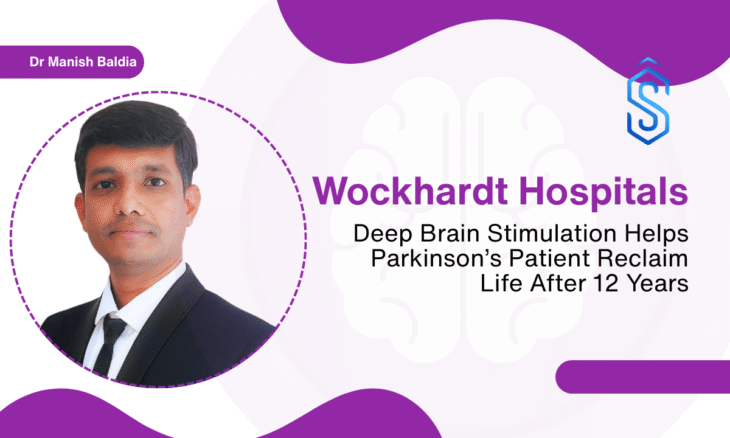
Mumbai: In a remarkable medical recovery enabled by Deep Brain Stimulation, Wockhardt Hospitals, Mumbai Central, helped a 66-year-old woman living with advanced Parkinson’s disease regain mobility, facial expressions, and emotional engagement after more than a decade of progressive decline.
The patient had been battling Parkinson’s disease for over 12 years. As the condition advanced, her weight dropped to just 30 kilograms, leaving her extremely frail and dependent on others for basic movement.
She had developed the “masked face” commonly associated with advanced Parkinson’s, while walking had become rigid and painful. Medications had also stopped delivering meaningful relief, limiting her daily life to survival.
She was evaluated by Dr Manish Baldia, Consultant Functional Neurosurgeon, who recommended Deep Brain Stimulation (DBS) – a minimally invasive surgical procedure that regulates abnormal brain signals responsible for Parkinson’s symptoms.
Considering her fragile physical condition and extremely low body weight, the decision required detailed medical planning and extensive counselling with the family.
“We took time to explain every aspect of the procedure to the family,” said Dr. Baldia. “Their questions were thoughtful and protective, which is exactly how such decisions should be made. Importantly, very low body weight alone is not a contraindication for DBS.”
Also Read: CPR Training for AutoRickshaw Drivers: KIMS Hospitals Builds Community First Responders
Deep Brain Stimulation Surgery Planned with Precision
Following meticulous planning and advanced targeting, the Deep Brain Stimulation surgery was performed successfully without complications. Special precautions were taken to ensure surgical precision given the patient’s frail condition.
This was followed by gradual, individualized post-operative programming to optimize outcomes.
In the weeks after the procedure, the patient showed significant improvement. Rigidity reduced, walking became easier, and facial expressions gradually returned.
Severe abdominal discomfort eased, and Parkinson’s medications were eventually discontinued. She also gained 7–8 kilograms, reflecting improved appetite, strength, and overall well-being.
Emotional Recovery Highlights the Impact of Deep Brain Stimulation
Beyond clinical improvement, the emotional transformation was equally striking. Family members observed her reconnecting with everyday personal routines – choosing her clothes, applying cream, and looking at herself in the mirror – activities that had disappeared over the years.
One of her children later shared with the medical team that it was the first time in many years they had seen her smile naturally and celebrate festivals with genuine happiness.
Also Read: NRoute Launches Heartisafe for Primary Cardiovascular Prevention
For Dr. Baldia, this represents the true purpose of functional neurosurgery.
“DBS is not just about improving movement. It’s about restoring dignity, confidence, and the sense of self that Parkinson’s slowly takes away.”
This case demonstrates how Deep Brain Stimulation, combined with expert neurosurgical care and a patient-first approach at Wockhardt Hospitals, can meaningfully transform lives even in advanced and medically fragile stages of Parkinson’s disease.